

Why We Don’t Talk About Death
In many Western cultures, death is something we don’t talk about very much. It feels uncomfortable, even frightening — yet it’s one of the few certainties in life. Our silence often comes from fear: fear of the unknown, of losing control, of facing our own mortality. But by avoiding death, we also avoid important conversations about love, loss, and what it means to live fully.
As one modern reflection reminds us:
“Do not let the fear of death make you forget how to live.” (Author unknown)
What Is Grief and Loss?
Grief is a natural and deeply human response to loss — not only the death of a loved one but also changes that reshape our sense of identity: the end of a relationship, a life-altering diagnosis, a child leaving home, or retirement.
Grief is a personal and unique experience for everyone affected by loss. Everyone grieves differently. There’s no right or wrong way to do it. Some people express emotions openly; others process quietly or through action. Grieving doesn’t mean something is wrong with you — it’s a normal, healthy process of adaptation.
Sometimes, though, grief can feel stuck — as if the world has moved on, but you haven’t. This is when therapy or counselling can offer space and support to make sense of it all.
🌊 The River of Life and the Whirlpool of Grief
Imagine your life as a river — flowing, changing, sometimes calm, sometimes stormy. When loss occurs, it’s as though your river hits a sudden bend or waterfall. You might find yourself caught in a whirlpool, circling through waves of emotion, confusion, or exhaustion.
The River of Life metaphor helps people locate where they are in their grief journey. Are you in the whirlpool, swirling with pain? Floating in calmer waters? Or beginning to find a new course downstream? Counselling can help you navigate this river, acknowledging that every person’s flow is different.
🌀 Complicated Grief: When Grief Feels Stuck or Intensified
Sometimes, grief is more complex than we expect. Complicated grief can occur when emotions feel overwhelming, persistent, or conflicting, making daily life difficult. This can also happen when relationships were complicated, unresolved, or fraught with tension, or when there are feelings of guilt, regret, or anger intertwined with loss.
You might find yourself:
-
- Feeling stuck in intense sadness, longing, or anger long after a loss.
- Experiencing guilt or regret about what was said, left unsaid, or decisions made.
- Struggling to reconcile mixed emotions toward the person you’ve lost — love, resentment, relief, or disappointment.
- Avoiding reminders of the loss or, conversely, feeling consumed by memories.
It’s important to remember: all grief is valid. Complicated grief doesn’t mean you’re failing; it signals that your mind and heart need extra support to navigate tangled emotions. Grief counselling or therapy can offer a safe space to untangle these feelings, acknowledge the complexity of your relationships, and gently work toward understanding, acceptance, and peace — at your own pace.
💔The Stages of Grief: The Kübler-Ross Model
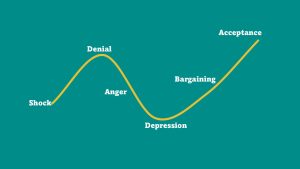
Psychiatrist Elisabeth Kübler-Ross identified five emotional experiences often observed in people facing loss: Denial, Anger, Depression, Bargaining, and Acceptance. These stages are not a linear path to follow — they’re more like emotional landmarks. You might move between them, skip one, or revisit another months or years later. The model helps us recognise that grief is dynamic, not predictable.
🌟 David Kessler’s Sixth Stage of Grief: Meaning
Grief expert David Kessler, who worked closely with Kübler-Ross, later introduced a sixth stage: Meaning. This stage isn’t about finding something positive in the loss or forcing acceptance. Instead, it’s a gentle invitation to explore how life can grow around grief.
Finding meaning is deeply personal. It may look like:
- Honouring the values or qualities your loved one embodied
- Continuing a tradition or ritual that connects you to them
- Recognising how you’ve changed, grown, or deepened through loving and losing
- Carrying their influence forward into your choices or relationships
- Creating something new, such as a project, practice, or gesture in their memory
Meaning doesn’t erase grief — it grows alongside it. In many ways, it echoes Tonkin’s idea that life expands around loss. For some, meaning emerges quietly over time; for others, it is something they actively seek.
Kessler emphasises that meaning isn’t about making sense of what happened. It’s about discovering how your love, bond, and experiences continue to shape your life in a way that feels authentic and sustaining.
🕯️Worden’s Four Tasks of Mourning
Psychologist William Worden reframed grief as a series of tasks rather than stages. His Four Tasks of Mourning are:
- To accept the reality of the loss
Acknowledging that the person or situation is gone. - To process the pain of grief
Allowing yourself to feel — even when it’s hard. - To adjust to a world without the deceased
Finding new roles, routines, and a sense of purpose. - To find an enduring connection while moving forward
Carrying love and memory with you, while continuing to live.
These tasks invite movement and growth — they’re not about “letting go,” but about integration.
⚖️ Stroebe & Schut’s Dual Process Model of Coping with Bereavement
In 1999, psychologists Margaret Stroebe and Henk Schut introduced the Dual Process Model of Coping with Bereavement. It describes how healthy grieving involves oscillating between two types of coping:
- Loss-oriented coping: confronting pain, memories, and emotions.
- Restoration-oriented coping: rebuilding life, taking on new responsibilities, finding balance.
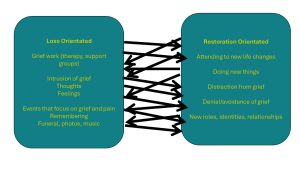
We move back and forth between these two modes. If we stay only in pain or only in avoidance, we can become overwhelmed or disconnected. Therapy can help people find a rhythm between feeling and rebuilding.
🌱 Growing Around Grief: Tonkin’s Model
The Tonkin Model of Grief suggests that we don’t “get over” grief — our grief stays the same, but our life grows around it.
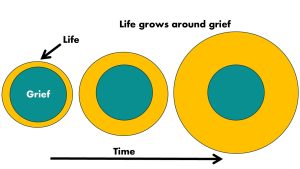
Over time, our world expands to include new experiences, joy, and meaning, even while the grief remains part of who we are. Healing doesn’t mean forgetting; it means learning to live fully alongside our loss.
🌍 Diversity and Culture in Grieving
Grief is universal, but how we grieve is shaped by culture, community, and belief.
In Western cultures, grief is often seen as private — something to manage quietly and efficiently. In contrast, many other cultures see mourning as a shared, ritualised experience: collective ceremonies, open expressions of sorrow, or ongoing connection with ancestors.
There is no single “right” way to grieve — only the way that feels authentic to you. Recognising diversity in grief helps us build compassion across differences.
Campaigns like Dying Matters encourage open, honest conversations about death and dying — helping people plan ahead, share wishes, and reduce the fear that often surrounds the topic
When to Seek Grief Counselling or Support
You don’t need therapy to grieve — grief itself is a natural process. But therapy can offer support when:
- You feel trapped in sadness, guilt, or numbness
- You’ve lost a sense of identity or purpose
- You’re struggling with practical changes after loss
- You feel isolated or unable to talk about your grief
Grief counselling can help you make sense of your emotions, rediscover meaning, and move gently through your River of Life — at your own pace.
✨ Final Reflection
“Grief never ends… but it changes.
It’s a passage, not a place to stay.
Grief is not a sign of weakness,
nor a lack of faith —
it is the price of love.”
— Author Unknown
Grief reminds us how deeply we have loved. It’s not something to fix, but something to be lived.
📩If you are struggling following a loss or need someone to talk to about your grief, please get in touch
📚 Further Resources, campaigns and support
- Dying Matters – UK campaign encouraging open conversations about death, dying, and bereavement.
- Cruse Bereavement Support – Free grief support and resources in the UK.
- Mind – Bereavement Support
- Marie Curie – Coping with Grief